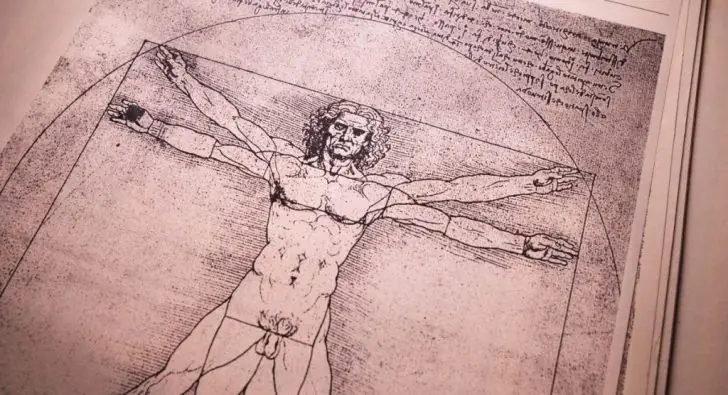
Leonardo da Vinci never did anything by accident. Even his quick sketches feel intentional, so when a modern researcher noticed a tiny equilateral triangle tucked between the legs of the figure in the Vitruvian Man, it sparked a fresh look at a drawing people thought they already understood.
What came next surprised both art lovers and scientists. That small triangle connects Leonardo’s famous work to a universal geometric rule that appears in crystals, biological systems, and even within the human jaw.
This new insight comes from Dr. Rory Mac Sweeney, a London dentist who works with geometric patterns every day. His discovery pulls back the curtain on a long-standing mystery around the drawing’s proportions. Many assumed Leonardo followed the Golden Ratio, but the measurements never matched it cleanly. The hidden triangle finally explains what Leonardo was really doing and why it matters far beyond art history.
Hidden Geometric Secret With Big Implications
The problem is simple. It did not fit the actual measurements in the drawing. Something else guided Leonardo’s design.
Dr. Mac Sweeney looked at the triangle formed between the figure’s wide stance, a shape Leonardo mentions directly in his notes. By calculating how the triangle fits within the square and circle, he found that the ratio between the square’s side and the circle’s radius falls between 1.64 and 1.65. That number is surprisingly close to 1.633, the exact tetrahedral ratio.
This ratio describes the height-to-base relationship in a tetrahedron. A tetrahedron is the most stable and efficient structure for stacking spheres in three-dimensional space.
This ratio shows up in crystal formations, molecular structures, and biological patterns. It is a kind of blueprint for optimal packing and stability. If that same ratio appears in the Vitruvian Man, it means Leonardo tapped into a principle that reaches far beyond art. He captured a rule that nature uses over and over to organize space with maximum efficiency.
Dentistry employs a principle known as Bonwill’s Triangle, which influences the alignment of teeth and the jaw. Bonwill’s Triangle also relies on the 1.633 ratio. Dr. Mac Sweeney recognized this number instantly because he works with it daily. That connection suggests Leonardo noticed a similar spatial logic in the human body long before dentistry formalized it.
A Closer Look at Leonardo’s Masterpiece
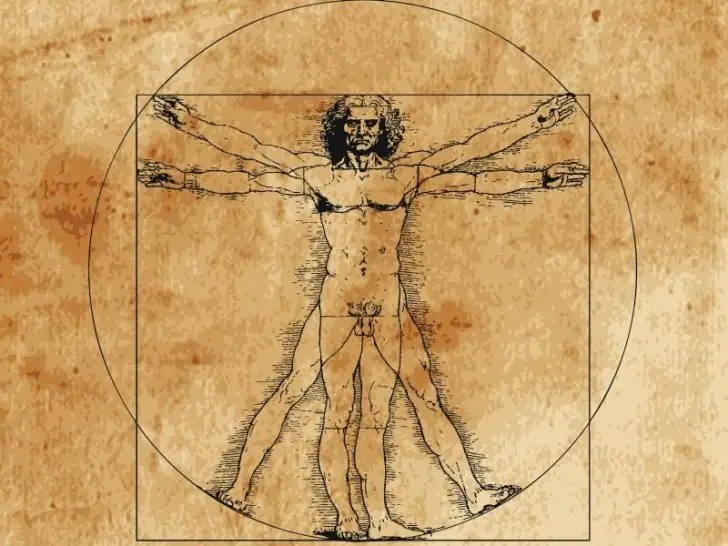
Vitruvius treated the body as a map of perfect order. Leonardo saw a chance to dig deeper.
Created around 1490, the drawing blends art, science, and mathematics. It reflects the Renaissance goal of finding harmony between knowledge and observation. Leonardo did not simply copy Vitruvius. He studied real bodies, adjusted the proportions, and added insights based on his own research. That is why historians refer to it as a thoughtful reinterpretation rather than an illustration.
The discovery of the tetrahedral ratio supports the view that Leonardo went far beyond Vitruvius. He built a system of proportions that not only matched the ancient text but also reflected natural geometry. This makes the drawing not just a study of human shape but also a study of natural order.
The tetrahedral ratio’s appearance suggests Leonardo understood something powerful. He viewed the human body as a physical manifestation of the same patterns observed in crystals, molecules, and natural structures.