The future of the solar system has long been a topic of scientific curiosity. Now, fresh observations from the James Webb Space Telescope (JWST) have provided one of the clearest glimpses yet into what that distant future might look like.
Astronomers studied a rare gas giant exoplanet orbiting a dead star about 80 light-years from Earth, offering valuable clues about how planets can survive the dramatic death of their host stars.
The remarkable system not only challenges previous ideas about planetary evolution but also provides a possible preview of what could happen to the outer planets in the solar system billions of years from now.
A Rare Planet Orbiting a White Dwarf
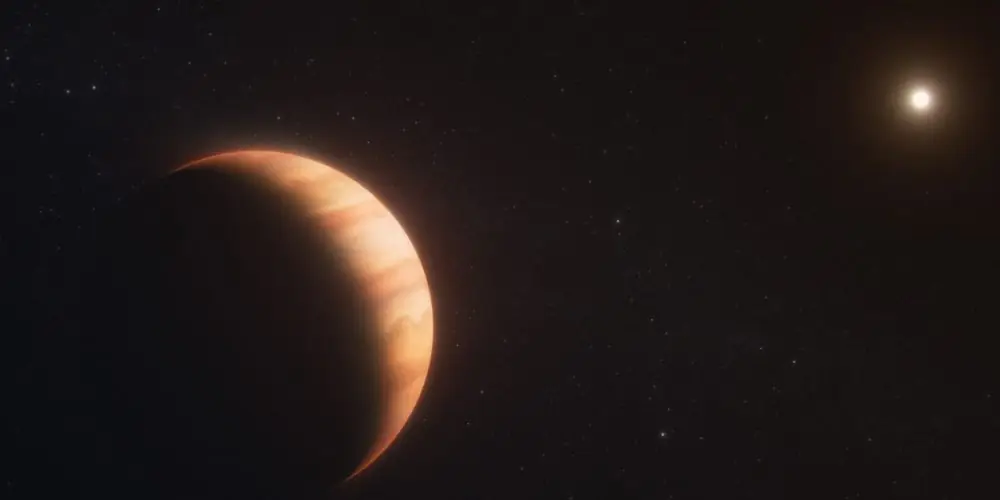
The focus of the study is WD 1856 b, a Jupiter-sized exoplanet that circles the white dwarf star WD 1856+534. A white dwarf is the dense stellar remnant left behind after a Sun-like star exhausts the hydrogen in its core, expands into a red giant, and sheds its outer layers.
Scientists believe the Sun will undergo this same transformation in nearly 6 billion years. During its red giant phase, it is expected to engulf the inner rocky planets, including Earth. However, the outer planets could survive, although their orbits and environments would change dramatically. WD 1856 b presents an opportunity to study what that future may look like.
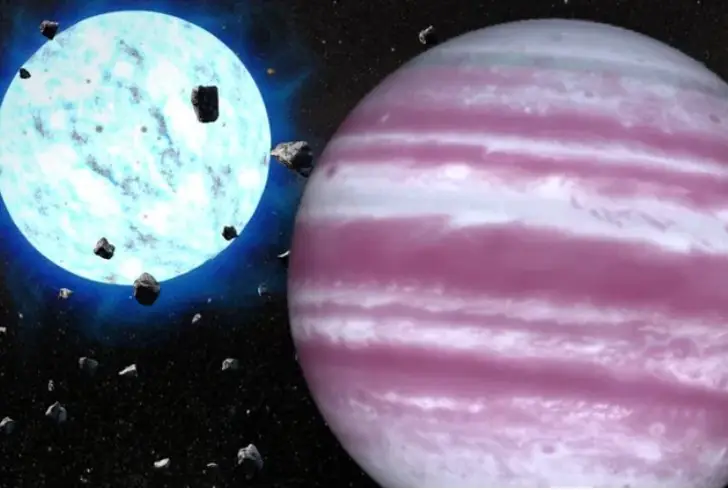
As the planet passes in front of its host star, a process known as a transit, the James Webb Space Telescope measured its mass, temperature, and atmospheric composition. The observations also helped researchers investigate how the giant planet reached its current orbit.
Ryan MacDonald from the University of St Andrews in Scotland explained the importance of the discovery, saying:
“We’re used to looking back in time when we use telescopes, but this is the first time we have been able to look forward to what might happen to the outer planets around the remnant of a sun-like star; it’s like using a time machine to peer into the distant future of our solar system.”
MacDonald also noted:
“This is just the beginning of our exploration of planets orbiting dead stars with Webb, and the search for further planets orbiting white dwarfs is ongoing.”
Why WD 1856 b Stands Out
WD 1856 b was first discovered in 2020 through observations made by NASA’s Transiting Exoplanet Survey Satellite (TESS) and the Spitzer Space Telescope. TESS identifies planets by detecting small drops in a star’s brightness when a planet crosses in front of it.
The discovery immediately caught astronomers’ attention because WD 1856 b became the first intact planet found in a close orbit around a white dwarf.
Its orbit is especially unusual. The planet circles its host at a distance equal to only about 2% of Earth’s distance from the Sun and completes one orbit in just 1.4 Earth days.
MacDonald highlighted another striking feature of the system:
“The planet is quite the oddball. It’s about the size of Jupiter, but the white dwarf it orbits is the size of Earth, so the planet is seven times larger than its star.”
Such a close orbit could not have existed before the host star became a white dwarf. If the planet had originally orbited at this distance, it would have been destroyed when the star expanded into a massive red giant.
Solving the Planet’s Mystery
Astronomers have debated how WD 1856 b reached its current position. Two leading explanations have been considered.
One possibility suggests the planet was swallowed by its host star during the red giant phase but somehow survived inside the expanding star before reappearing in a close orbit.
The second theory proposes that the planet originally orbited much farther away and gradually migrated inward because of gravitational interactions with other objects in the system.
Christopher O’Connor of Northwestern University explained both possibilities:
“The big question is how WD 1856 b ended up where it is today, and there are two theories.”
He added:
“One is that the planet was swallowed by the host star as it was dying, and managed to survive on the inside. The other is that the migration took place due to the gravitational effect of other objects in the system. The white dwarf is part of a triple star system, and the outer companion stars could have influenced WD 1856 b’s orbit.”
The James Webb Space Telescope provided a critical clue by measuring the planet’s temperature.
An Unexpected Temperature
Researchers found that WD 1856 b has a temperature of approximately 260 degrees Fahrenheit (127 degrees Celsius). That makes the planet about 240 degrees hotter than expected if it were heated only by the faint light from its white dwarf host.
Since the white dwarf cannot produce enough energy to explain the extra heat, scientists concluded that the planet must still be cooling from a much hotter period in its history.
The team also measured the planet’s mass, estimating it to be between four and eleven times the mass of Jupiter. These measurements allowed researchers to model its cooling history and determine when the planet likely experienced intense heating.
Their analysis suggests WD 1856 b became extremely hot between 3 billion and 5.5 billion years ago. Because its host star has already existed as a white dwarf for longer than that, the findings strongly indicate the planet remained at a safer distance during the destructive red giant stage and migrated inward only after the star completed its transformation.
O’Connor explained:
“As the planet moved inwards, its interactions with the strong gravity of the white dwarf will have caused it to warm up considerably, and it has been cooling ever since.”
What This Means for the Solar System

The observations suggest that giant planets such as Jupiter could experience similar orbital changes long after the Sun reaches the end of its life. While the inner planets are expected to disappear during the Sun’s red giant phase, the outer planets may survive and gradually move closer to the remaining white dwarf.
The discovery also highlights the remarkable capabilities of the James Webb Space Telescope. White dwarfs are extremely faint compared to the stars typically observed by Webb, making these measurements especially challenging.
Victoria Boehm of Cornell University described the difficulty of the observations:
“White dwarfs like WD 1856 are exceptionally dim compared to the planet-hosting stars we normally observe with the JWST.”
She also pointed out the short observation window:
“To make things even harder, the planet’s transit only lasts 8 minutes, so it’s very much if you blink you miss it! Capturing enough light to see WD 1856’s spectrum, while also doing so quickly enough to not miss the transit, is something only Webb can do.”
The findings were published in the journal *Nature* in July and mark another milestone in the search for planets orbiting white dwarfs.
What Scientists Learned
The study of WD 1856 b provides one of the strongest examples yet that planetary systems can continue evolving even after their stars die. The evidence indicates the gas giant avoided destruction during its host star’s red giant phase before gradually settling into its present orbit around the white dwarf.
MacDonald summarized the broader significance of the discovery:
“Our results show that stellar death is not the end — some planets experience a vibrant and lively future after the death of their star.”
As the James Webb Space Telescope continues examining similar systems, astronomers expect to discover more planets orbiting white dwarfs. Each new observation will improve the understanding of how planetary systems change over billions of years and may offer an increasingly detailed preview of the solar system’s distant future.