
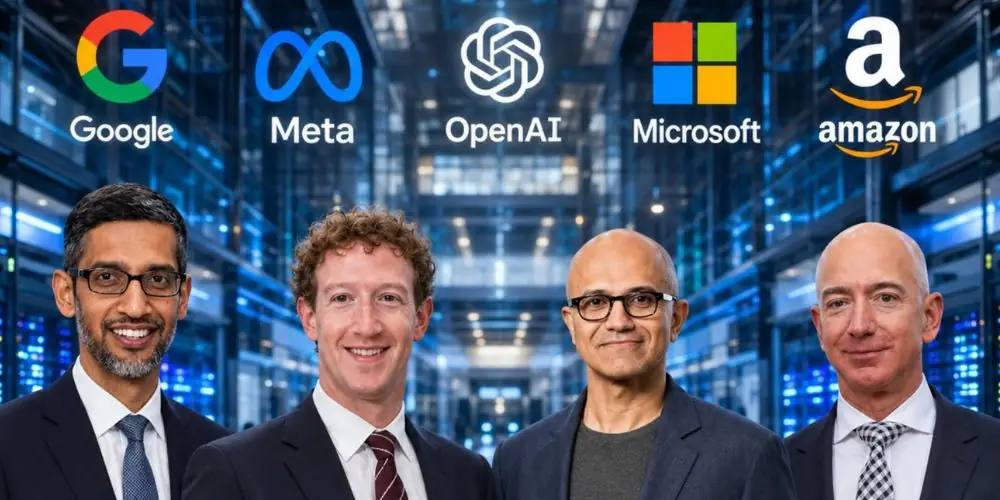
Artificial intelligence has become the centerpiece of the technology industry’s growth strategy. Companies are investing enormous sums in AI infrastructure, data centers, and advanced computing systems, expecting that future demand will justify the expense.
Yet recent market movements suggest that investors are no longer satisfied with promises alone. They want evidence that these investments can generate meaningful revenue and profits.
A sharp decline in technology stocks this week highlighted growing concerns across Wall Street. The Nasdaq Composite Index dropped nearly 5% as investors questioned whether the trillions being poured into AI can deliver returns large enough to support the industry’s spending spree.
Why Investors Are Growing Cautious
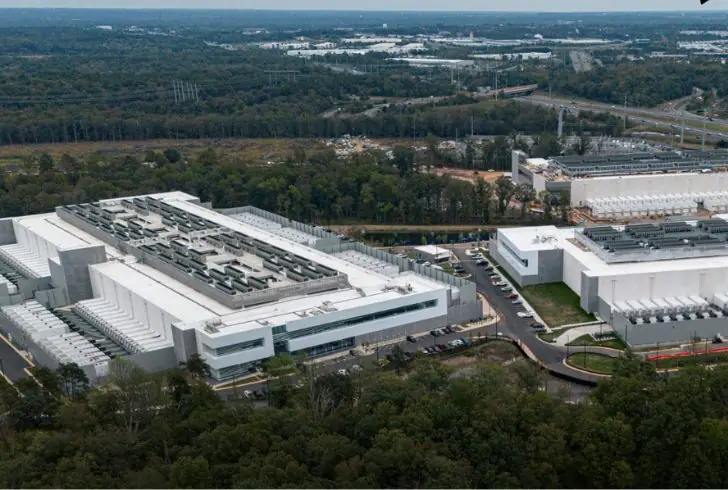
The scale of AI investment is difficult to ignore. According to Goldman Sachs, technology companies are expected to spend approximately $7.6 trillion by 2031 on building thousands of data centers needed to support AI development and deployment.
Major technology companies, including Alphabet, Amazon, Meta, Microsoft, and Oracle, continue to expand their AI infrastructure at an aggressive pace. Many are also turning to debt financing to fund these projects, raising concerns about long-term profitability.
Kate Brennan, Associate Director at independent research institute AI Now, pointed to the increasing reliance on borrowing to support AI expansion.
“There’s concern around how much hyperscalers are turning to debt markets to finance the infrastructure buildout.”
Brennan also questioned whether current AI investments are producing the expected outcomes.
“The returns are not coming in, and the claims that are being made, in terms of efficiency or productivity numbers, are not netting out.”
These comments reflect a broader concern across financial markets. While spending continues to rise, clear evidence of significant financial returns remains limited.
Adoption Does Not Always Equal Revenue
AI usage continues to grow across the United States. Search engines, customer service systems, productivity tools, and digital assistants increasingly rely on AI-powered features. However, widespread use has not translated into widespread willingness to pay.
Many consumers interact with AI because it has become integrated into everyday digital experiences. A Google search now frequently displays AI-generated answers at the top of results. Customer support calls often connect users to AI-powered agents designed to sound human.
Brennan argues that much of the current adoption is being driven by business incentives rather than direct customer demand.
“The current push for AI adoption that we’re seeing is directly coming from the financial incentives of AI firms.”
She added that major AI companies are deliberately integrating AI into as many products and services as possible, regardless of whether consumers actively seek those features.
At the same time, public skepticism remains significant. According to Pew Research, 40% of adults believe AI will hurt society over the next two decades. Only 16% view its long-term effect positively.
Businesses Are Still Waiting for Results

Companies across various industries have started replacing certain tasks with AI systems. In many cases, organizations are reducing headcount while increasing investment in AI technologies.
Yet the financial benefits remain uncertain.
A May study conducted by technology research firm Gartner found that businesses replacing workers with AI agents often struggle to achieve a positive return on investment. The findings suggest that AI adoption alone does not guarantee lower costs or higher profits.
This uncertainty adds another layer of risk for investors who are already concerned about the pace of spending.
Is the AI Market Entering Bubble Territory?
Questions about an AI bubble have circulated for months. Strong performance from companies such as Alphabet and Nvidia has helped push U.S. stock markets to record highs, prompting comparisons to the internet boom of the late 1990s.
Many investors see similarities between today’s AI enthusiasm and the dot-com era. During that period, countless internet companies attracted huge investments before many eventually collapsed. At the same time, survivors such as Amazon and Google grew into some of the world’s most successful businesses.
According to Qian Wang, Global Head of Capital Market Research at Vanguard, and Senior Global Economist Kevin Khang, AI’s future is unlikely to produce equal outcomes for every participant.
“Some firms may emerge as more profitable and with significant competitive advantages, while others could find their core businesses obsolete in a new AI economy.”
They noted that investors are still trying to understand several key factors, including the future pace of AI capital spending, how effectively large technology firms can monetize their investments, and the true size of the AI market.
As a result, market volatility is expected to remain elevated.
“Investors should expect a bumpy ride.”
Not all economists believe the current AI rally can continue indefinitely.
Jonas Goltermann, Chief Markets Economist at Capital Economics, believes momentum in AI-related stocks is beginning to slow. Although he expects technology-heavy markets in the United States and Asia to outperform in the near term, he also anticipates the possibility of significant declines by 2027.
Such forecasts highlight the tension between AI’s long-term potential and current market valuations.
Can AI Pay for Itself?
At the center of the debate lies a simple question: can AI generate enough revenue to justify the industry’s enormous capital expenditures?
Economist Ed Yardeni of Yardeni Research believes this issue is critical to understanding the future of AI-related investments.
Companies such as Alphabet, Amazon, Meta, and Microsoft continue investing heavily in chips, computing capacity, and data centers. At the same time, AI developers, including OpenAI and Anthropic, rely on these facilities to train and operate large language models.
The challenge is determining whether future demand will generate enough revenue to support the entire ecosystem.

Yardeni issued a clear warning:
“The AI ecosystem falls apart if the expected end-user demand for the AI/LLM products does not materialize or if prices for their offerings fall sharply below expectations.”
To evaluate sustainability, Yardeni’s team conducted what they describe as a “capex payback test.” The analysis examined annualized revenue projections for OpenAI and Anthropic to determine whether user growth is expanding quickly enough to support existing spending commitments.
The results suggest that AI revenues currently fall short of fully supporting industry-wide investment levels. However, projected growth over the coming years paints a more encouraging picture.
According to Yardeni:
“We find that the AI ecosystem is not fully end-user revenue-backed yet, but it is not entirely speculative either.”
He added that revenue forecasts through 2030 improve the outlook considerably, though those projections depend on continued growth and ongoing improvements in computing efficiency.
What Comes Next for AI Investment?
Artificial intelligence remains one of the largest investment themes in the global economy.
Technology leaders continue building infrastructure at a remarkable pace, betting that future demand will eventually justify today’s spending. At the same time, investors are becoming more selective and are demanding measurable results rather than ambitious projections.
The coming years will likely determine whether AI follows the path of internet pioneers who created lasting value or whether parts of the industry struggle under the weight of expectations.
For now, the market remains focused on one test above all others: whether AI can convert massive spending into sustainable revenue growth.