The internet has produced countless urban legends, but few have captured public imagination like the Backrooms.
What started as a single unsettling image has grown into one of the web’s most recognizable fictional worlds. Although the Backrooms exist only online, millions of people continue to explore, discuss, and expand the mysterious setting through videos, games, artwork, and social media.
As filmmaker Kane Parsons prepares a feature-length adaptation, interest in this strange digital universe continues to spread far beyond online communities.
What Are the Backrooms?
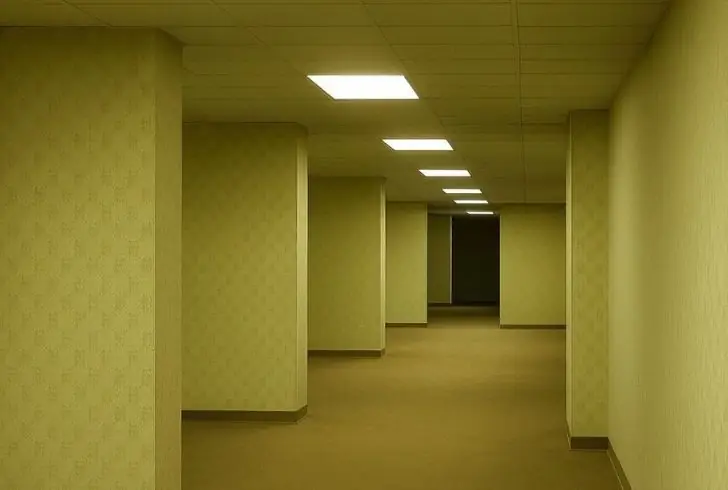
The Backrooms are a fictional internet setting imagined as an endless maze of empty rooms lit by buzzing fluorescent lights. The idea suggests that someone can accidentally slip out of ordinary reality and become trapped inside this endless network of yellow-walled corridors with no obvious way out.
The concept first appeared in 2019 on the online message board 4chan. A single anonymous post featured an unsettling image of vacant office-like rooms covered with faded yellow wallpaper, worn carpets, and bright ceiling lights.
Soon after, internet users began creating stories describing the location as a hidden dimension just beyond normal reality.
Instead of remaining a simple image, the Backrooms quickly developed into a collaborative online myth. Communities across Reddit, TikTok, YouTube, and gaming platforms added new locations, survival guides, fictional journals, maps, and mysterious creatures, creating a constantly expanding fictional universe.
Kane Parsons’ Backrooms Vision
One of the biggest reasons for the Backrooms’ popularity is filmmaker Kane Parsons. His YouTube “found footage” series presented the fictional world through realistic camera work and unsettling storytelling, making viewers feel as though they were walking through the endless hallways themselves.
Rather than relying on static internet images, Parsons created immersive videos that blended analog horror with realistic visual effects. The series helped turn the Backrooms into one of social media’s most recognizable horror settings.
Now that Parsons is developing the Backrooms into a feature-length horror thriller, the fictional world is attracting even greater attention from mainstream audiences.
More Than Internet Horror Story
At first glance, the Backrooms may appear similar to famous internet creepypastas such as Slenderman or “The Russian Sleep Experiment.” However, researchers suggest the phenomenon represents a larger cultural shift in how people experience fictional environments online.
Unlike traditional horror stories with fixed plots, the Backrooms continue to grow through contributions from thousands of users. Every new video, game, illustration, or fictional report becomes part of the larger mythology.
This open structure allows people to participate instead of simply watching from the sidelines. The experience feels less like reading a horror story and more like exploring an unfamiliar place.
Folklore scholar Michael Kinsella describes this type of participation as “online legend-tripping,” where audiences become contributors, collaborators, and world-builders rather than passive spectators.
Why Familiar Spaces Feel Unsettling
Part of the Backrooms’ appeal comes from their ordinary appearance. The endless hallways resemble outdated offices, empty hotels, abandoned shopping centers, school corridors, or forgotten commercial buildings. These are places many people have seen before, yet rarely pay close attention to.
That familiarity creates an unusual emotional response. Nothing appears immediately dangerous, yet everything feels strangely wrong. The silence, repetitive design, and endless empty rooms create tension without relying on monsters or dramatic action.
Because the Backrooms never explain exactly what happened, visitors fill the gaps with their own imagination. That uncertainty keeps discussions active across multiple platforms.
Social Media Expanding the World

The Backrooms continue to grow because the internet treats them as an ongoing collaborative project rather than a finished story.
The Reddit community r/backrooms includes hundreds of thousands of members who regularly post theories, artwork, fictional documents, and new room designs. TikTok has accumulated more than half a million posts using the hashtag #backrooms, while Instagram accounts such as @xbackroom have attracted hundreds of thousands of followers through edited images, speculative stories, and visual concepts.
Instead of following a single official storyline, creators continue to add new levels, characters, and survival ideas. Video games, virtual reality experiences, YouTube videos, and first-person explorations allow audiences to interact with the environment rather than simply observe it.
A New Form of Digital Tourism
Researchers studying dark tourism have long observed that people are drawn to places connected with tragedy, disaster, abandoned buildings, and unsettling history. Visitors often seek locations that evoke emotional or psychological responses rather than mere entertainment.
The Backrooms introduce a different version of that experience.
Unlike virtual tours of real-world historical sites, the Backrooms have neither a physical location nor a documented past. They exist entirely as a fictional online world built through collective imagination. That absence of a fixed history encourages users to create their own interpretations, making every exploration feel different.
The Backrooms highlight how digital culture is changing the way people interact with fictional worlds. Rather than following a single storyline, audiences help expand the universe through videos, games, artwork, and online discussions.
This shared creativity blurs the line between storytelling, role-playing, and virtual exploration.
As interest continues to grow and Kane Parsons develops a feature-length film, the Backrooms remain one of the internet’s most influential fictional creations. What began as a single anonymous image has become a collaborative digital destination that millions continue to explore, despite existing only online.